M&A advisory is a professional service that helps companies buy, sell, merge, or restructure businesses by managing valuation, deal strategy, due diligence, negotiations, and transaction execution. Advisors act as strategic and financial partners, ensuring business owners maximize value, reduce risk, and close deals efficiently.
M&A advisory services help companies protect value, strengthen deal terms, and manage risk throughout every stage of a transaction. Many deals fail to deliver expected results; globally, only about 52% of M&A transactions are considered successful. That’s why you need experienced support in strategy, negotiation, and post-deal integration for improving the odds of a strong outcome.
Key Takeaways
M&A advisory acts as a strategic bridge that guides business owners through the complex financial and legal hurdles of buying or selling a company.
Professional valuation and preparation ensure you don't leave money on the table and identify your company's true market worth.
Advisors provide critical risk mitigation and identify potential "deal killers" during due diligence before they can derail a transaction.
A competitive bidding environment created by an advisor’s network is the most effective way to maximize the final sale price and improve deal terms.
Maintaining strict confidentiality throughout the process protects your business operations, employees, and customer relationships until the deal is finalized.
Understanding the Basics of M&A Advisory
At its core, M&A advisory is a professional service in which experts guide companies through buying, selling, or merging with other businesses. This includes both buy-side M&A advisory, where advisors help clients identify, evaluate, and acquire target companies, and sell-side M&A advisory, where they support business owners in preparing, marketing, and selling their company at the best possible valuation. An M&A advisor acts as a bridge between a company’s current position and its future ownership or growth strategy.
These advisors are typically seasoned professionals with deep expertise in finance, negotiation, valuation, and industry-specific trends. Their primary objective is to maximize client value while minimizing financial, legal, and execution risks throughout the transaction lifecycle, from strategy and due diligence to deal structuring and closing.
The Difference Between M&A Advisors and Business Brokers
While the terms are often used interchangeably, there is a distinction. Business brokers generally handle smaller, main-street businesses (like a local dry cleaner or a small retail shop). M&A advisors typically handle larger, middle-market companies. M&A advisory involves a more sophisticated level of financial modeling, strategic positioning, and a more extensive network of institutional buyers.
The Core Phases of the M&A Process
M&A advisory is not a single event but a journey that consists of several critical phases. An advisor provides support through each step to ensure nothing is overlooked.
Preparation and Valuation
Before a business goes to market, an advisor performs a deep dive into the company’s financials. They help determine the "Enterprise Value" of the firm. This involves more than just looking at a balance sheet; it includes assessing intangible assets, market position, and growth potential.
Marketing and Identifying Targets
Once the business is ready, the advisor creates a "CIM" (Confidential Information Memorandum). This document highlights the business's strengths to potential buyers. Advisors use their vast networks to identify "strategic buyers" (competitors or companies in related industries) and "financial buyers" (private equity firms).
Due Diligence and Negotiation
When an interested party makes an offer, the due diligence phase begins. This is a rigorous investigation where the buyer verifies every claim made by the seller. M&A advisors manage this data flow and lead the negotiations on price, terms, and deal structure to ensure the seller’s interests are protected.
Key Services Provided by M&A Advisors
A comprehensive M&A advisory firm offers a suite of services designed to streamline the transaction.
Strategic Planning
Advisors help business owners align their personal goals with their business goals. If an owner wants to retire in three years, the advisor will help implement strategies to "clean up" the books and increase the company’s valuation before the sale.
Deal Structuring
Not all deals are cash-up-front. M&A advisors help navigate complex deal structures, including:
Asset vs. Stock Sales: Deciding which is more tax-efficient.
Earn-outs: Where a portion of the purchase price is paid later based on performance.
Seller Financing: Where the seller acts as the "bank" for a portion of the deal.
Risk Mitigation
Transactions can fall apart for dozens of reasons: legal disputes, financial discrepancies, or culture clashes. M&A advisors identify these "deal killers" early in the process and address them before they reach the closing table.
Key M&A Advisory Service
What It Involves
Why It Matters
Strategic Planning
Aligning the owner’s personal goals with business goals, preparing financials, and improving valuation ahead of a sale.
Ensures the business is optimized for maximum value and ready for a successful exit.
Deal Structuring
Designing optimal transaction structures, including asset vs. stock sales, earn-outs, and seller financing.
Improves tax efficiency, flexibility, and overall deal attractiveness for both parties.
Risk Mitigation
Identifying and resolving potential deal risks such as legal issues, financial gaps, or cultural conflicts.
Reduces the chance of deal failure and protects value through to closing.
Why Business Owners Need M&A Advisory
Many entrepreneurs believe they can sell their own business. However, the DIY approach often leads to "money left on the table" or, worse, a failed transaction.
Access to a Wider Network
An advisor has access to proprietary databases and relationships with private equity groups and corporate development teams that the average business owner simply does not have.
Emotional Neutrality
Selling a business is an emotional process. It is the culmination of years of hard work. An M&A advisor provides a level-headed, objective perspective, ensuring that emotions don't derail a beneficial deal during tense negotiations.
Maintaining Confidentiality
If employees, customers, or competitors find out a business is for sale prematurely, it can cause significant damage. M&A advisors manage the process through "blind profiles" and strict non-disclosure agreements (NDAs) to keep the sale quiet until it is the right time to announce it.
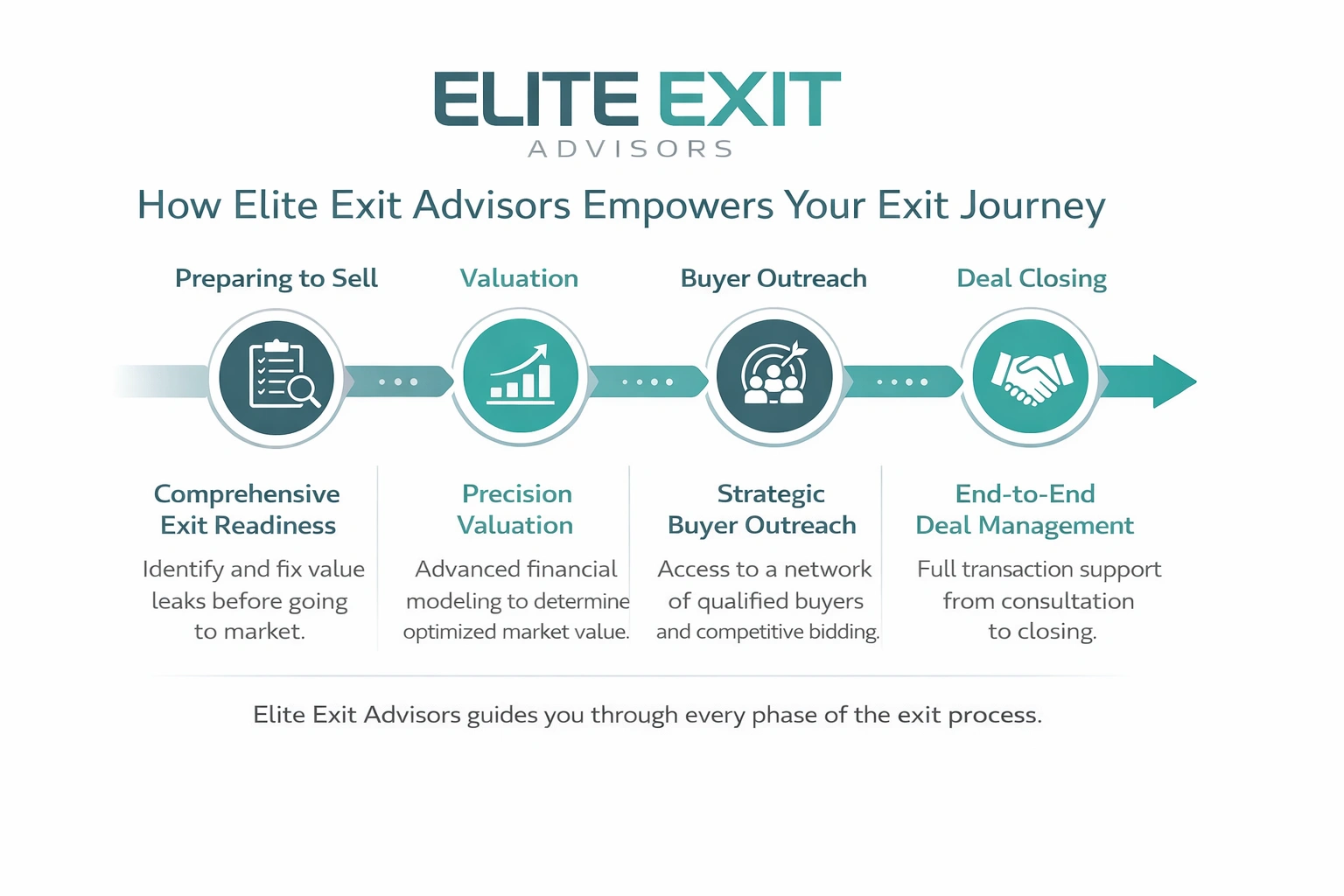
How Elite Exit Advisors Empowers Your Journey
Elite Exit Advisors specializes in guiding business owners through every stage of the exit process, ensuring you receive the maximum value for your life's work. We provide a structured, results-driven approach tailored to your specific industry and goals:
Comprehensive Exit Readiness: We assess your business from a buyer’s perspective to identify and fix value leaks before you hit the market.
Precision Valuation: Using advanced modeling, we determine a realistic and optimized market value for your company.
Strategic Buyer Outreach: We leverage an extensive network of qualified buyers to create a competitive bidding environment.
End-to-End Deal Management: From the initial consultation to the final signature, we handle the heavy lifting so you can focus on running your business.
If you are considering a sale or simply want to know what your business is worth in today’s market, we invite you to take the next step. Book a call with Elite Exit Advisors today to start planning your successful transition.
Conclusion
M&A advisory is the difference between simply closing a deal and achieving an optimal exit. M&A advisors provide expertise in valuation, marketing, and negotiation, and ensure that business owners can transition to their next chapter with financial security and peace of mind. Whether you are buying or selling, having the right experts in your corner is the most important investment you can make.
FAQs
How Long Does the M&A Process Typically Take From Start to Finish?
›
While every transaction is unique, a typical middle-market M&A deal takes between 6 to 12 months. This timeline accounts for the initial preparation and valuation (1–3 months), marketing and buyer outreach (2–4 months), and the intensive due diligence and legal closing phase (2–3 months). Factors such as industry regulations or the cleanliness of financial records can either accelerate or extend this window.
How Are M&A Advisors Typically Compensated?
›
Most M&A advisors operate on a "success-based" fee structure. This usually includes a modest upfront retainer or monthly work fee to cover the initial costs of marketing and materials, followed by a success fee paid at closing. The success fee is typically a percentage of the total enterprise value, often following a sliding scale where the percentage decreases as the deal size increases.
Will I Have to Stay With the Business After the Sale Is Finalized?
›
In most middle-market transactions, the buyer will require the owner to stay on for a transition period. This can range from a few months of consulting to a multi-year employment contract. The goal is to ensure a smooth handoff of key relationships and institutional knowledge. If your goal is a clean break, an M&A advisor can help target buyers who already have a management team ready to step in.
What Is an "Earn-out" and Should I Accept One?
›
An earn-out is a contractual provision where a portion of the purchase price is paid after the closing, contingent on the business hitting specific financial targets. While sellers generally prefer all-cash deals, earn-outs can bridge the "valuation gap" when a buyer and seller disagree on the future growth potential of the company. Your advisor will help negotiate the metrics to ensure they are fair and achievable.
What Are the Most Common Reasons That M&A Deals Fall Apart?
›
The most frequent "deal killers" include due diligence surprises (undisclosed liabilities or declining financials), cultural misalignment between leadership teams, and financing issues on the buyer's side. M&A advisors perform "pre-due diligence" to catch these issues early, allowing you to fix them before a buyer ever sees them.
Do I Need an M&A Advisor if a Competitor Has Already Made an Offer?
›
Yes. When a single buyer approaches you, they have the advantage of a "non-competitive" environment. An M&A advisor creates a competitive auction process, bringing multiple bidders to the table. Even if you end up selling to that original competitor, the presence of other interested parties significantly increases your leverage to negotiate a higher price and better terms.
How Do I Know if My Business Is Actually "Ready" for a Sale?
›
A business is "exit-ready" when it can operate successfully without the daily involvement of the owner. Key indicators of readiness include three years of audited or reviewed financials, a diversified customer base (no single client representing more than 10-15% of revenue), and a strong middle-management team. Elite Exit Advisors can perform a readiness assessment to show you exactly where you stand.

.webp)
.webp)