

M&A advisory services guide business owners and leadership teams through complex transactions, sales, purchases, mergers, divestitures, or restructurings, and provide strategic planning, valuation, buyer or target identification, diligence coordination, deal structuring, and negotiation support.
Simply put, an M&A advisor works to maximize deal value and reduce execution risk across the full lifecycle of a transaction. These services matter because deal success is far from guaranteed: globally, the average M&A deal success rate is about 52%, which is why expert guidance in planning, negotiation, and integration to improve outcomes is important.
When a company plans a sale, purchase, or corporate reshaping, structured external guidance brings clarity and control.
M&A advisory means a disciplined, expert-led process to prepare for and execute an acquisition, sale, merger, divestiture, or restructuring. Advisors help set strategy, value the business, identify buyers or targets, coordinate diligence, and lead negotiation.
Investment banking typically focuses on very large transactions and complex financing. Dedicated advisors concentrate on middle- and small-market deals where hands-on execution matters more.
Business brokers handle simpler, smaller sales. They often reach local or individual buyers and provide lighter valuation and negotiation support than an advisor handling a complex transaction.
Buy-side M&A advisor centers on target screening, assessing strategic fit, valuation discipline, and managing due diligence. Sell-side M&A advisor focuses on positioning the company, running buyer outreach, creating competitive tension, and optimizing terms.
Decision cues: seek help now if inbound offers appear, lenders ask for audited valuation, leadership changes create urgency, or market shifts compress timelines. Matching the right expert to the deal context, especially when private equity or complex financing is involved, improves outcomes.
An experienced advisor coordinates every stage so leadership can focus on decisions that matter. They link the transaction to strategy: defining whether the goal is growth, exit, or portfolio reshaping and mapping a realistic path to close.
Clarify objectives, set success metrics, and prioritize target profiles. This creates a working M&A strategy with clear milestones, owners, and accountability.
Buyer lists are not just names. Advisors use market and industry insights to rank fit, willingness to transact, and likely valuation ranges.
Valuation blends fundamentals with comparable transactions. Advisors translate that into negotiation ranges and walk-away thresholds to protect value.
Structure shapes risk and upside, price adjustments, earn-outs, seller notes, rollover equity, and working capital mechanics. Skilled negotiation manages timing and information flow to reduce post-close disputes.
Advisors coordinate with banks and capital partners to match debt and equity options to the chosen structure and buyer/seller priorities.
Integration starts before signing. Day One readiness, an Integration Management Office, and a synergy capture plan help realize the value thesis faster.
.webp)
Thorough due diligence turns assumptions into facts and protects value before you sign. Research shows roughly 60% of transaction failures tie back to poor diligence, so an early fact base matters.
Due diligence is not a checklist: it validates the investment thesis, confirms price and terms, and surfaces deal breakers early. Good diligence shortens integration timelines and lowers unexpected post-close costs.
Assess market demand, customer concentration, differentiation, pricing power, and competitive stance. These checks test whether positioning will hold under new ownership and support revenue forecasts.
Examine quality of earnings, working capital behavior, margin durability, and realism of synergy claims. Rigorous review reveals execution risks that can erode projected value.
Review systems readiness, data integrity, integration complexity, and security exposure. IT and cyber gaps often create surprise costs or regulatory headaches after close.
Assess leadership depth, retention risk, incentive alignment, and culture fit. People issues frequently determine whether integrations achieve their promised gains.
Map required approvals, structural options, and transaction tax implications. Early mitigation plans reduce the chance of costly delays or post-close liabilities.
Bottom line: disciplined diligence lowers risk and improves the odds of a successful M&A transaction and creates a clear, actionable fact base for pricing, structure, and integration.
A clear view of pricing, real economics, and synergy plans helps leaders separate headline offers from true outcomes.
Enterprise value rests on revenue quality, margin profile, and cash conversion. Recurring revenue and durable growth raise multiples.
Customer concentration and one-time sales depress perceived value. Reliable cash conversion supports higher offers.
Buyers and sellers value different things. Buyers focus on upside and integration risk. Sellers want price certainty and timing.
An advisor translates performance into a defensible valuation narrative using comparable transactions and clear metrics.
Synergies split into cost (procurement, overhead) and revenue (cross-sell, channel access). Each has required investments and timelines.
Turn synergy assumptions into measurable initiatives with owners, KPIs, and deadlines so the combined company captures value fast.
The team you hire shapes market access, negotiation leverage, and the speed of your deal. Match industry and market experience to your company size and buyer universe. Relevant experience shortens the learning curve and improves credibility with buyers.
Prior transactions in your sector matter more than broad credentials. Look for teams that have closed deals of similar scale and know buyer motivations.
Typical roles include a senior lead, valuation and modeling specialists, legal/tax coordinators, IT and integration experts, and analyst support. One experienced advisor often manages the process and adds specialists when complexity rises.
Ask about weekly checkpoints, milestone reviews, and who will be your day-to-day contact. Expect NDAs, staged data-room access, and controlled messaging to staff and key customers.
.webp)
Understanding how advisors charge lets you compare proposals and protect expected proceeds. Costs usually combine an upfront retainer and a success fee tied to the transaction value. Clear terms up front reduce negotiation friction and help owners budget for the process.
Retainer: covers planning, preparing marketing materials, initial outreach, and coordination. Typical retainers range roughly from $25,000 to $100,000+ depending on workload and timeline.
Success fee: paid at close and is commonly a percentage of deal value. Percentages often fall in the ~1%–5% range, and can be higher on smaller transactions to reflect fixed effort.
Complexity raises fees. Multiple bidders, carve-outs, cross-border rules, heavy diligence, or layered capital structures require more hours and specialist input. Buy-side support, sell-side mandates, or narrow workstreams also change pricing.
An experienced advisor reduces execution risk, shields terms through better structure, and keeps management focused on running the business. That can preserve or increase net proceeds beyond headline price.
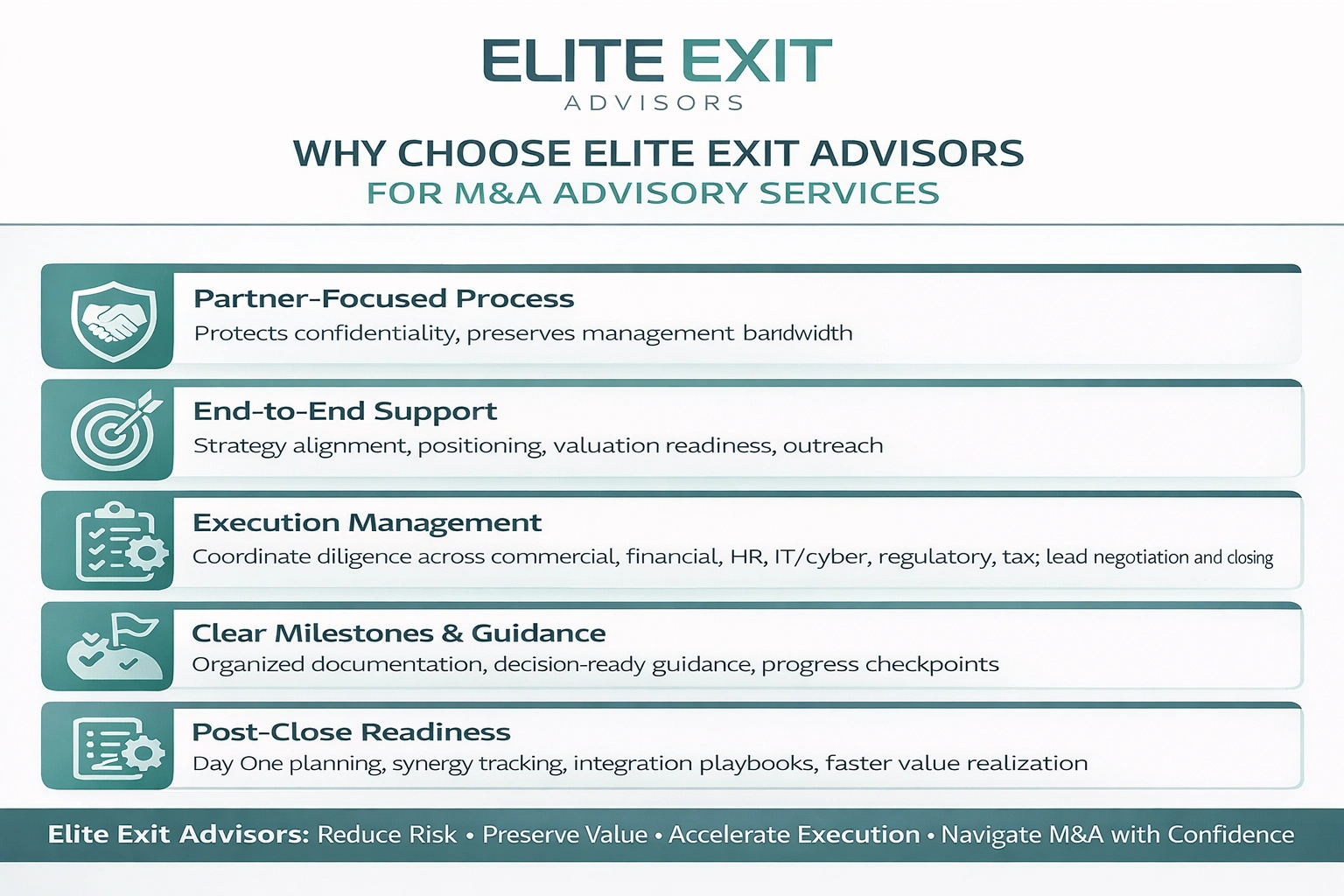
Elite Exit Advisors partners with owners and leadership teams who want a disciplined, confidence-building M&A process that protects confidentiality and preserves management focus.
We support preparation and execution end-to-end. That includes strategy alignment, positioning, and valuation readiness before outreach.
During execution, we manage outreach, coordinate diligence across commercial, financial, HR, IT/cyber, regulatory, and tax areas, and lead negotiation and closing activities.
Engagements follow clear milestones and timelines. You receive organized documentation, decision-ready guidance, and regular progress checkpoints.
Practical benefits: fewer surprises, stronger negotiation leverage, and better alignment between deal terms and real-world execution.
We also build post-close readiness, Day One planning, synergy tracking, and integration playbooks, so value is realized after signing, not just at close.
Ready to discuss your goals? Book a call with Elite Exit Advisors to explore a tailored approach that fits growth plans, partial or full exit, or portfolio reshaping while managing risk and maximizing value.
M&A advisory services bring structure, discipline, and market insight to decisions that permanently shape enterprise value. Whether the objective is growth through acquisition, a partial or full exit, or a strategic reshaping of the business, experienced advisors reduce risk, protect confidentiality, and help translate headline offers into real outcomes. The right advisory partner aligns strategy with execution, manages complexity across valuation, diligence, and negotiation, and keeps leadership focused on what matters most.
For U.S. business owners and executive teams, engaging an M&A advisor early is about maximizing value, preserving options, and moving through a high-stakes transaction with confidence.