
Roofing business valuation is the process of estimating what a roofing company is worth based on earnings, cash flow, growth potential, customer base, assets, and risk, so owners, buyers, and investors can make informed decisions about selling, buying, or scaling. With the U.S. roofing market estimated at $24.79 billion in 2025, understanding your company’s true value is more important than ever in this growing industry.
The valuation of a roofing company provides a clear picture of its financial health, operational efficiency, and market position, which are critical factors in making informed business decisions.
One of the primary reasons roofing business valuation matters is that it facilitates succession planning or the sale of the business. When the accurate value of the company is determined, owners can set realistic expectations and negotiate effectively with potential buyers or successors. This process ensures a smooth transition and helps in maximizing the return on investment for the business owner.
Roofing businesses often require significant capital for expansion, equipment upgrades, or to cover operational costs. A professional valuation can provide lenders and investors with the confidence they need to provide financing. When owners demonstrate the value of the business, they can secure better loan terms and attract investors who are looking for a strong return on their investment.
Valuation is a tool for strategic business planning. Understanding the value of different aspects of the business helps owners identify areas of strength and weakness. This insight enables them to make informed decisions about where to invest, how to optimize operations, and which strategies to implement to increase the overall value of the company.
In addition to its role in planning and financing, roofing business valuation is also important for insurance and legal purposes. Accurate valuations can help in determining the appropriate level of insurance coverage and can be critical in legal disputes or when dealing with tax authorities.
.webp)
Several factors impact the valuation of a roofing business, including financial metrics, business age, and customer loyalty.
Revenue and profitability are fundamental to assessing the financial health of a roofing business. Valuation experts often examine metrics such as gross revenue, net profit margins, and EBITDA (Earnings Before Interest, Taxes, Depreciation, and Amortization) to gauge profitability. A business with strong, consistent revenue streams and healthy profit margins is generally valued higher than one with erratic financial performance.
The age and reputation of a roofing business significantly influence its valuation. Established businesses with a long history of quality service and a strong market reputation tend to be valued higher due to their reliability and customer trust. Newer businesses, while potentially having modern advantages, may face challenges in establishing credibility and thus might be valued lower unless they have other compensating strengths.
Factors such as customer reviews, ratings, and the business's standing within the community play arole in determining its reputation. A well-maintained brand image and positive customer feedback can enhance the business's value.
A robust and loyal customer base is a valuable asset for any roofing business. Valuation experts assess customer retention rates and the overall customer lifecycle to understand the stability and potential future earnings of the business. High customer retention indicates a reliable revenue stream and reduces the risk for potential buyers or investors.
Diversification of services can significantly impact the valuation of a roofing business. Companies offering a range of services, such as roofing repairs, installations, and maintenance contracts, tend to be more resilient to market fluctuations and attract a broader customer base. This diversification can lead to a more stable revenue stream and enhance the overall value of the business.
Roofing businesses can be valued using a range of methods, each with its own strengths. Understanding these different approaches helps in determining the accurate worth of a roofing company.
Asset-based valuation involves assessing the value of a roofing business's tangible assets, such as equipment, vehicles, and property. This method is particularly useful when the business has significant physical assets.
Key components of asset-based valuation include:
Income-based approaches focus on the income generated by the roofing business. This method is beneficial for businesses with a strong, consistent revenue stream.
Common income-based valuation techniques include:
Market-based valuation involves comparing the roofing business to similar businesses that have been sold recently. This approach provides a benchmark based on market realities.
Key factors in market-based valuation include:
Rule of thumb methods provide a simplified way to estimate the value of a roofing business based on industry-specific metrics.
Examples of rule of thumb methods include:
Each of these valuation methods has its strengths and limitations. The choice of method depends on the specific circumstances of the roofing business, including its financial performance, market conditions, and the purpose of the valuation.
Valuing a roofing business requires a thorough understanding of its assets, which is where the asset-based approach comes into play. This method involves assessing both the tangible and intangible assets of the company to determine its overall value.
Tangible assets are the physical components of a roofing business that contribute to its operational capabilities.
The valuation of equipment and vehicles is a significant part of the asset-based approach. This includes assessing the condition, age, and market value of roofing equipment, trucks, and other vehicles used in the business.
This encompasses the value of roofing materials, supplies, and any other goods held for sale or use in the business. For accurate valuation of inventory, take into account factors like obsolescence and market demand.
Intangible assets, while not physical, play a significant role in the value of a roofing business. These assets can often be the differentiating factors that set one company apart from another.
The brand value of a roofing company represents its reputation, customer loyalty, and overall market presence. Assessing brand value involves analyzing factors such as customer perception, brand recognition, and the competitive landscape.
Customer relationships are an intangible asset for roofing businesses. The strength and longevity of these relationships can significantly impact the company's future revenue streams. Valuing customer relationships involves examining customer retention rates, contract terms, and the overall customer experience.
The value of a roofing business can be accurately assessed using various income-based valuation techniques. These methods focus on the financial performance and potential of the company, providing a comprehensive view of its worth.
The capitalization of earnings method involves converting a company's earnings into value and applying a capitalization rate. This rate is determined based on the risk associated with the business and the expected return on investment.
Key advantages: Simple to apply, considers the company's profitability.
Limitations: Assumes a constant earnings stream, sensitive to capitalization rate.
Discounted cash flow (DCF) analysis is a more complex method that estimates the present value of future cash flows using a discount rate. This approach is particularly useful for businesses with fluctuating income.
Key advantages: Accounts for future growth, considers the time value of money.
Limitations: Requires accurate forecasting, sensitive to discount rate.
Adjusted EBITDA (Earnings Before Interest, Taxes, Depreciation, and Amortization) multiples involve adjusting the EBITDA figure to reflect the true profitability of the business, then applying a multiple to determine value.
Key advantages: Provides a clear picture of profitability, widely used in business valuation.
Limitations: Multiple selection can be subjective, may not account for all expenses.
Roofing businesses often experience seasonal fluctuations in revenue. To accurately value such businesses, normalize earnings over the year or adjust the valuation method to account for these fluctuations.
Key considerations: Historical data analysis, seasonal indexing.
The market comparison approach offers a practical way to determine a roofing company's value, as it looks at recent sales of similar businesses. This method is particularly useful in the roofing industry, where local market conditions and business characteristics can significantly impact a company's worth.
To apply the market comparison approach effectively, find reliable and relevant sales data from comparable roofing businesses. This involves:
Sources for comparable sales data include business brokers, industry associations, and publicly available records of business sales.
When using the market comparison approach, adjust for differences between the businesses being compared. Factors to consider include:
Adjusting for these differences ensures that the comparison is as accurate as possible, providing a more reliable valuation.
Regional market conditions can significantly impact the value of a roofing business. Factors such as local economic conditions, competition, and regulatory environment should be considered when applying the market comparison approach.
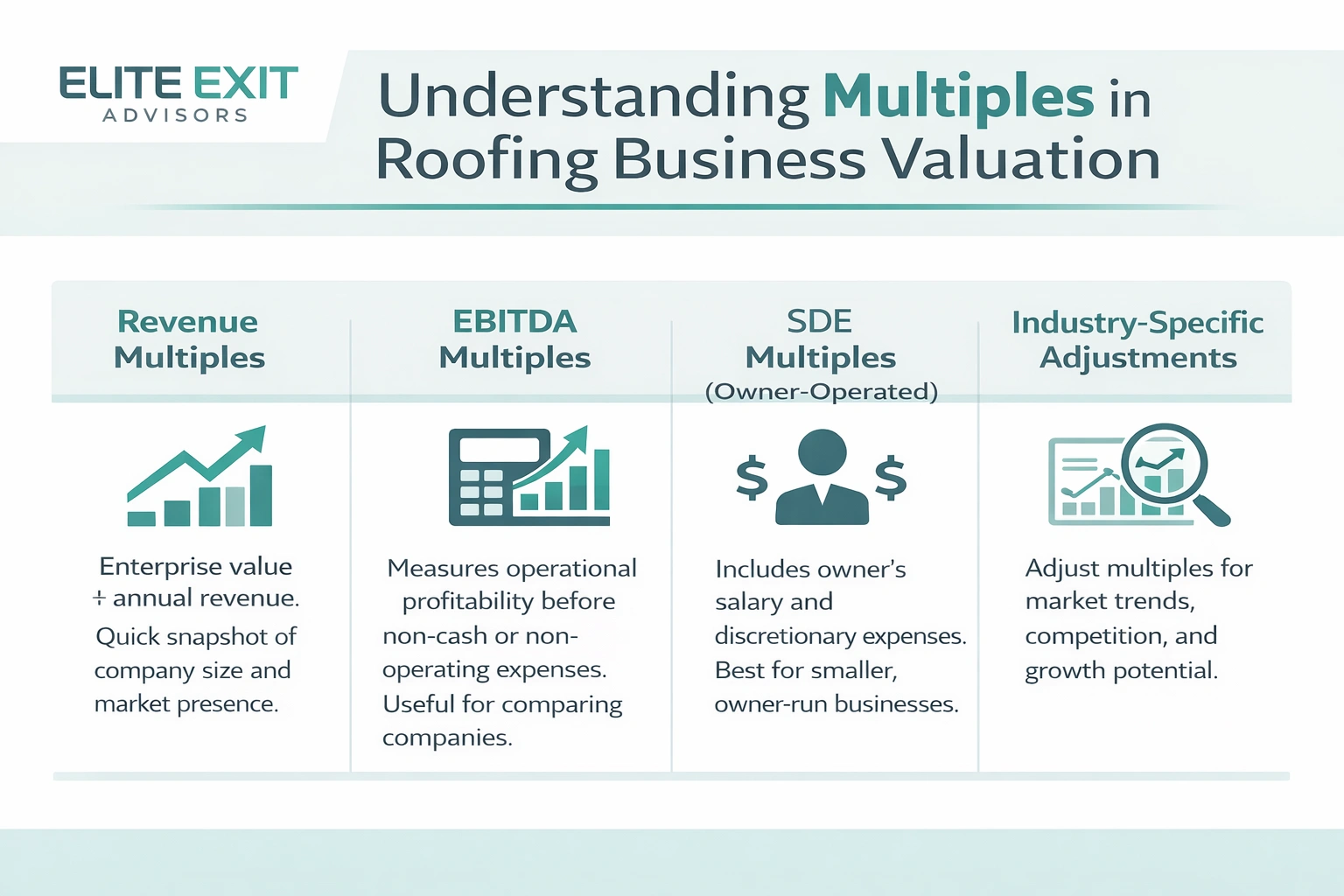
To accurately value a roofing business, grasp the concept of multiples and their application. Multiples are a metric used in business valuation to estimate the worth of a company by comparing it to similar businesses.
The use of multiples in roofing business valuation provides a straightforward method to determine a company's value based on its financial performance. There are several types of multiples used, each with its own significance.
Revenue multiples are calculated by dividing the enterprise value of a company by its annual revenue. This method is particularly useful in the roofing industry, where revenue can be a significant indicator of a company's size and market presence.
Key advantages of using revenue multiples include:
EBITDA (Earnings Before Interest, Taxes, Depreciation, and Amortization) multiples are another widely used metric. They measure a company's profitability before non-operating items and non-cash expenses.
EBITDA multiples are particularly useful because they:
For owner-operated roofing businesses, Seller's Discretionary Earnings (SDE) multiples are often used. SDE includes the owner's salary and other discretionary expenses, providing a more accurate picture of the business's profitability.
The benefits of using SDE multiples include:
When using multiples for roofing business valuation, consider industry-specific factors that may impact the multiples. These can include market trends, competition, and the company's growth potential.
Adjusting multiples based on industry specifics involves:
The value of a roofing business is significantly impacted by its human capital, including management and crew members. A strong, skilled, and stable workforce can be a major differentiator in the industry, contributing to the overall valuation of the company.
The leadership and management team play an important role in the success and sustainability of a roofing business. When assessing management strength, consider factors such as:
The expertise and stability of the crew are vital components of a roofing business's workforce valuation. Consider the following:
Investing in employee training and certification programs not only improves the workforce's capabilities but also adds value to the business. Key aspects include:
These programs demonstrate a commitment to excellence and can be a significant selling point or value driver.
Factors to consider include:
A business with a good safety record is more attractive to potential buyers or investors, as it indicates a lower risk profile.
Roofing businesses with substantial recurring revenue tend to have higher valuations. Recurring revenue provides a predictable income stream, reducing the uncertainty and risk associated with the business. This stability is highly valued by investors and potential buyers.
Maintenance contracts ensure a steady flow of income over time, as they typically involve regular inspections and maintenance services. The value of maintenance contracts lies in their predictability and the long-term relationship they foster with customers.
Key benefits of maintenance contracts include:
Long-term service agreements (LTSAs) further contribute to the stability of a roofing business's revenue. LTSAs often involve comprehensive service packages that include repairs, replacements, and maintenance over an extended period. The long-term nature of these agreements provides a significant advantage in terms of valuation.
With the implementation of effective loyalty programs, roofing businesses can increase customer retention rates, leading to a more stable and predictable revenue stream.
Effective customer loyalty strategies include:
While warranties can be costly, they also provide an opportunity to build trust with customers and create a potential revenue stream through extended service agreements.
Businesses should carefully manage their warranty obligations to balance costs with the benefits of enhanced customer trust and loyalty.
To get an accurate valuation, roofing businesses must be prepared with comprehensive financial and operational data. This preparation not only streamlines the valuation process but also helps in identifying areas of improvement and potential value drivers.
This includes having detailed income statements, balance sheets, and cash flow statements readily available. Accurate and up-to-date financial records help in demonstrating the financial health and stability of the business.
Operational documentation provides insight into the day-to-day operations of the roofing business. This includes policies, procedures, and any relevant operational manuals. Having well-documented operational processes can highlight efficiency and potential for scalability.
This includes maintenance contracts, service agreements, and any other customer-related documents. Comprehensive contract documentation can demonstrate a stable revenue base.
Vendor relationships and supply chain documentation can reveal the strength of the business's network and its ability to negotiate favorable terms. Details about supply chain logistics and vendor agreements can highlight operational efficiencies and potential cost savings.
.webp)
Valuing a roofing business is a complex process, fraught with potential pitfalls that can significantly impact the final valuation.
One of the significant pitfalls in roofing business valuation is overlooking seasonal fluctuations in revenue and profitability. Roofing businesses often experience variability in demand due to weather conditions and seasonal changes, which can affect their financial performance. Account for these fluctuations when valuing a roofing business to avoid under or overvaluation.
Another common pitfall is the failure to normalize financial statements. Normalizing financials involves adjusting the financial records to reflect the true economic reality of the business, excluding non-recurring items and personal expenses. Normalized financial statements provide a clearer picture of the business's profitability and cash flow, leading to a more accurate valuation.
A company's market position, including its competitive advantages and market share, significantly influences its value. Understanding the business's standing within its market helps in determining its potential for future growth and profitability.
Undervaluing specialized expertise is another pitfall. The value of a roofing business can be significantly enhanced by the expertise of its management and workforce. Specialized knowledge and skills, such as those in roofing technology or safety protocols, can be a substantial asset, contributing to the business's competitive edge and overall value.
Boosting your roofing business's value involves a combination of strategic initiatives, process improvements, and diversification strategies. To achieve this, business owners must focus on enhancing their company's overall appeal to potential buyers or investors.
Implement strategic growth initiatives to increase your roofing business's value. This can be achieved through:
These initiatives not only drive revenue growth but also enhance the business's competitive edge.
Improve operational efficiency to maximize business value. Key areas to focus on include:
When businesses enhance their operational efficiency, they can achieve higher profitability and attractiveness to investors.
Diversification is a powerful strategy for increasing business value, as it reduces dependence on a single revenue stream. Roofing businesses can diversify by:
Diversification not only enhances revenue stability but also opens up new opportunities for growth.
Develop transferable systems to create a business that can operate effectively without the owner's direct involvement. This involves:
Professional roofing business valuation experts bring a level of precision and insight that's invaluable for business owners looking to understand their company's worth. The process of valuing a roofing business is complex, involving numerous factors that can significantly impact the final valuation.
Hiring a business appraiser is a decision that can significantly affect the outcome of your roofing business valuation. Consider hiring a professional when you're planning for succession or sale, seeking financing or investment, or involved in strategic business planning.
Select the right valuation partner to obtain an accurate and reliable business valuation. Look for professionals with experience in the roofing industry, a strong track record, and relevant certifications.
The valuation process involves a comprehensive analysis of your business, including financial records, operational documentation, and market positioning. Understanding what to expect can help you prepare and ensure a smooth process.
While the cost of hiring a professional valuation expert may seem significant, the value they bring to the process can far outweigh the expenses. A professional valuation can help you make informed decisions, avoid costly mistakes, and potentially increase the value of your business.
The benefits of professional valuation include:
Elite Exit Advisors are dedicated to helping roofing businesses achieve their financial goals through precise valuation and exit planning strategies. With a deep understanding of the roofing industry, they provide expert guidance tailored to the unique needs of each business.
Elite Exit Advisors works with service-based businesses, including HVAC business valuation, HVAC business valuation, plumbing business valuation, electrical contractor business valuation, and more, to provide precise, actionable insights.
Elite Exit Advisors employ a specialized approach to roofing business valuation, utilizing industry-specific methodologies to ensure accurate financial assessments. This involves a comprehensive analysis of financial records, market trends, and operational efficiencies.
Their comprehensive valuation services encompass a wide range of factors, including:
These services are designed to provide a thorough understanding of a roofing business's value, helping owners make informed decisions.
Elite Exit Advisors also offer exit planning and succession support, recognizing that the ultimate goal of many business owners is to transition their company successfully. This involves strategic planning to maximize business value and ensure a smooth transition.
The team at Elite Exit Advisors brings extensive experience in business valuation and exit planning, with a particular focus on the roofing industry. Their expertise enables them to navigate complex financial situations and provide actionable advice.
If you're a roofing business owner looking to understand your company's value or planning for the future, book a consultation with Elite Exit Advisors today. Their expert advisors are ready to help you achieve your financial goals.
Roofing business valuation comes down to understanding what truly drives your company’s earning power, risk profile, and long-term potential. Whether you’re planning to sell, bring on investors, secure financing, or simply benchmark performance, a clear and accurate valuation gives you leverage and direction.
When you improve financial clarity, reduce owner dependency, strengthen recurring revenue, and document operations, you can increase both the value of your roofing business and your negotiating power.
Elite Exit Advisors specializes in providing comprehensive valuation services tailored to the unique needs of roofing businesses. Their expertise can help business owners navigate the valuation process, ensuring that their company is presented in the best possible light to potential buyers or investors.