

Selling a service business is rarely a quick transaction. On average, the time it takes to sell a business ranges from 6 to 12 months, with many deals stretching closer to 10 months depending on preparation, backlog, and market conditions. That timeline alone explains why so many owners struggle to hit their goals when they decide to exit. Without advance planning, sellers often discover too late that buyers are not paying for hustle or personality, they are paying for reliable cash flow, transferable systems, and reduced risk.
Service businesses, like roofin, plumbing, construction, present a unique challenge because the value often lives in people, processes, and client relationships rather than physical assets. Buyers want proof that revenue will continue after the owner steps away. That means clean financials, documented operations, diversified clients, and a leadership structure that can run day-to-day work without constant owner involvement. When those pieces are missing, negotiations slow down, deal terms tighten, and sale timelines extend.
Planning an exit early gives owners time to shape value instead of chasing a last-minute price. Start with a clear statement of success: target sale price, desired post-close role, and how much free time you want back. Keep this concise and measurable.
Write three measurable outcomes: financial target, role after closing, and timeline for personal goals. These anchor decisions and guide investments in staffing, systems, and marketing.
Compare the main paths, full sale, passing the company to family, or a partial exit. Each path changes control, risk, and future income. Family succession needs explicit buy-in; without it, plans often shift toward an external sale.
Use a practical window of 12–36 months. In that span, clean financials, reduce owner dependence, and diversify clients. Avoid common mistakes: waiting too long, assuming succession without confirmation, or expecting a rapid sale without buyer-ready documents.
Most acquirers value predictability: steady margins, repeat customers, and solid reporting. Buyers buy future cash flow, so clean financials and consistent performance matter far more than flashy growth that lacks quality.
Predictable revenue raises confidence and value. Recurring contracts, memberships, or retained accounts show buyers that cash flow will persist after the owner departs.
Long-term agreements and renewal history reduce risk. When revenue is contracted or subscription-based, offers are typically stronger and terms are simpler.
Broad client mix protects valuation. Heavy dependence on a few clients can lower offers or add restrictive covenants in deals.
Positive reviews and clear differentiation drive lead flow and price power. Buyers assess brand trust, consistency of delivery, and comparative strengths in the market.
Due diligence looks for written delivery checklists, QA standards, training plans, safety logs, and compliance files. These reduce execution risk and speed transferability.
Buyers want people who can run day-to-day operations after closing. A stable team and proven managers protect revenue and ease transition.
Buyer-readiness checklist: reliable cash flow, diversified clients, documented processes, current compliance, and management depth.

A smooth transfer demands months of cleanup across finance, operations, and people before offers arrive. Rushing often forces bad trade-offs that cut value and add risk.
Valuation work, discreet buyer outreach, lender timelines, and thorough due diligence take time. Each step uncovers details that must be fixed before signing.
Rushing risks: lower price, tighter terms, employee churn, customer loss, and messy diligence that weakens buyer confidence.
Begin now, even if a sale is years away. Strengthen margins, document process flows, improve client retention, and reduce owner dependence.
Why early work pays off: these steps raise enterprise value and keep options open, full exit, partial transfer, or succession.
A clear valuation gives owners realistic bounds for negotiations and prevents costly surprises later.
Valuation is an opinion about what a company is worth and not always the final market price. An opinion helps set expectations; a market-clearing price reflects actual buyer demand and terms.
Buyers often rely on earnings multipliers (P/E), discounted cash flow (DCF), comparable sales, and asset-based methods. Multipliers matter when profits are stable. DCF fits when future cash can be forecasted. Comparables help when similar companies have recent sale data.
Key drivers include recurring revenue, low client concentration, depth in management, documented process, and strong reputation. Each element reduces risk and raises the multiple buyers will offer.
Local labor markets, regional demand, and sector trends change buyer appetite. Urban areas often command higher prices but bring wage pressure. Rural locations may lower offers due to hiring risk.
Confidence improves when valuation aligns with proven cash flow and clear records. That alignment makes negotiation smoother and increases buyer trust.
Well-prepared accounts frame revenue and cash flow in a way buyers trust. That trust shortens due diligence and raises confidence in the company story.
Buyer-ready means accurate P&Ls, current balance sheets, statements of cash flow, and a KPI dashboard that reconciles each month.
Clear separation reduces add-back disputes and preserves value. Unclear books slow deals and weaken trust.
Tighten scheduling, cut rework, enforce pricing discipline, and improve labor efficiency without harming reputation. Forecast weekly and plan working capital for slow seasons.
Use a reliable CPA or enrolled agent and review numbers with a CFO frequently. Create a due diligence file: organized reports, tax returns, payroll schedules, and reconciliations that speed the process.
Documented operations turn fragile know-how into repeatable value that buyers can run from day one. A clear operating structure reduces dependence on the owner and makes the company easier to transfer without major rebuilding.
Define each step: intake, scheduling, pre-job checklist, on-site standards, QA, invoicing, follow-up, and warranty handling. Written procedures cut down tribal knowledge and raise confidence during diligence.
A strong CRM creates pipeline visibility and repeatable lead handling. Track first contact, estimates, conversions, recurring work, and retention. This data proves predictable revenue and customer care.
The operations manual should list roles, SOPs, escalation paths, training plans, and service standards. The employee handbook sets expectations for people, conduct, and performance. Together they form the "business in a box" buyers want.
Organize safety training records, incident logs, and required OSHA 300 entries. Clean compliance files reduce diligence risk and protect valuation.

Owners who stop fixing day-to-day problems free time for strategic choices that grow value. That shift matters: buyers pay more for a company that runs without constant owner input.
Move from field tasks to setting strategy, tracking metrics, and shaping culture. Spend time on scorecards and hires, not service calls.
Delegate clear responsibilities and accept small errors as learning. Protect safety and compliance while letting people improve.
Hire or promote an operations lead, a scheduling/dispatch manager, a customer success owner, and a field lead for quality.
Use a simple org-chart and rhythm to make management repeatable:
Why this protects value: leadership depth keeps the company stable during diligence and lets owners reclaim time for growth work.
A transferable brand separates the company from any single person's reputation. If the owner is the main attraction, buyers fear clients will leave once leadership changes. That fear lowers offers and increases deal conditions.
Customers who buy "you" rather than the offering create churn risk. A buyer pays for predictable revenue, not for a personality that may exit overnight.
Shift messaging toward results: guarantees, clear deliverables, and repeatable experience. Make every touchpoint reflect the same promise.
Brand clarity raises buyer confidence and value. In the U.S., online reviews and local credibility matter. A transferable reputation reduces perceived risk and supports stronger offers.
Repeat customers reveal reliable delivery and steady cash flow, which buyers reward with higher value. Loyal clients lower risk and smooth revenue swings, making your company easier to price and transfer.
Use proactive follow-ups, automated service reminders, and membership or maintenance plans. Standardize QA and reduce callbacks. These steps increase repeat work and lift the lifetime value of clients.
Identify high-revenue accounts and measure concentration as a percent of monthly revenue. Run targeted marketing and expand service lines to new segments. Gradual diversification avoids sudden revenue shocks.
Keep scheduling stable, maintain scripted on-site checks, and hold regular team briefings. Shield frontline staff from deal noise so customers see consistent quality. That preserves reputation and value.
A steady lead engine turns marketing from an expense into a predictable growth lever. For a company preparing for exit, this means repeatable lead flow that does not depend on the owner’s personal network. Predictability in marketing reduces perceived risk and supports higher valuation.
Make the website a conversion hub: clear service pages, visible trust signals, and fast contact options. Show reviews, case results, and badges that prove credibility.
Include simple contact forms, click-to-call buttons, and a clear value proposition on every landing page. These small elements raise conversion rates and shorten the sales cycle.
Maintain a steady social media presence that highlights outcomes and client stories. Reviews, testimonials, and short case studies show durability of demand.
Social proof helps both customers and potential buyers see consistent performance across channels.
Record channel-level leads and the cost to acquire each customer. Track lead-to-sale conversion so you know what actually drives growth.
Tie marketing into the end-to-end customer flow: inquiry, booking, delivery, and follow-up. A documented flow improves customer experience while scaling and makes future performance easier for buyers to underwrite.
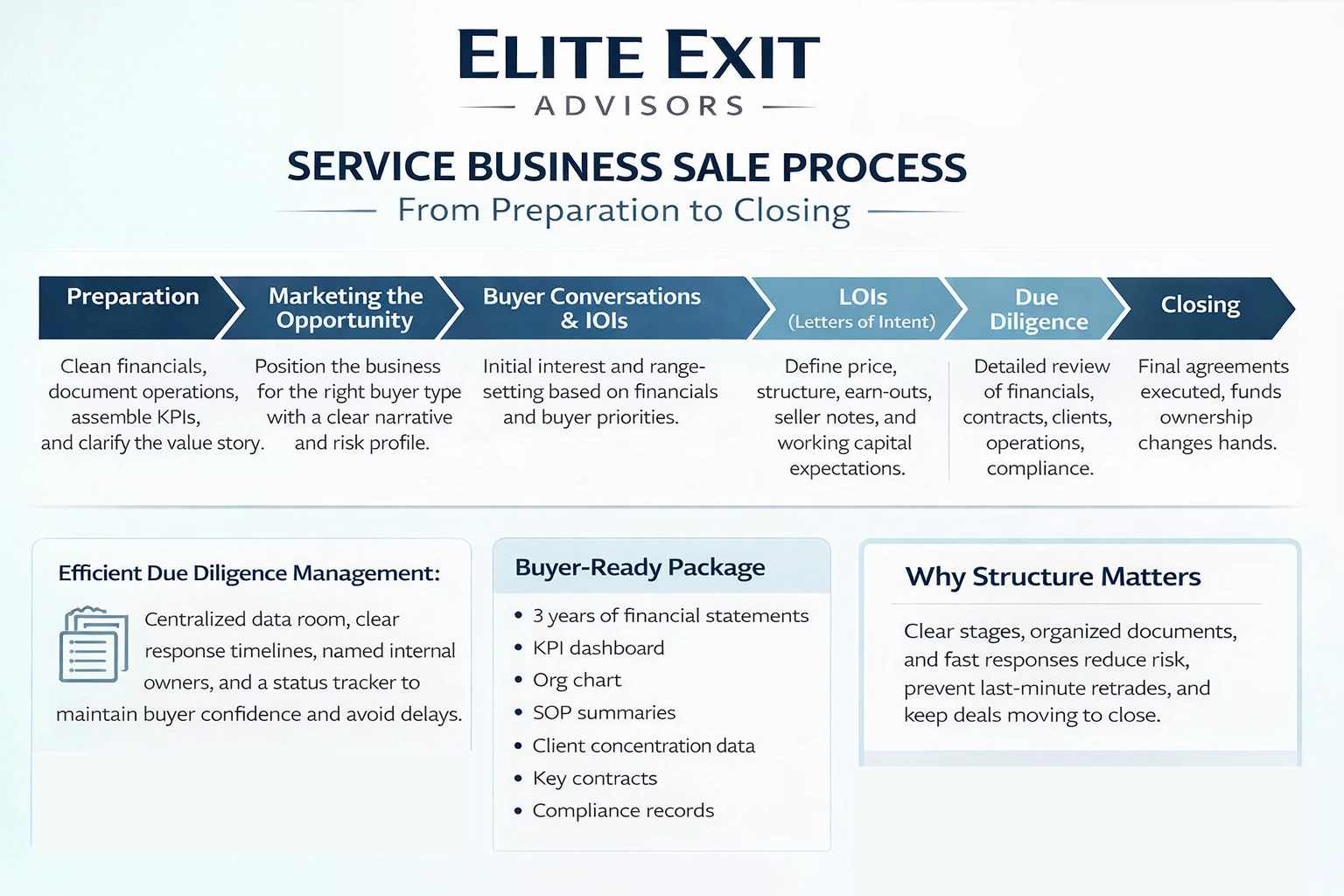
Structured stages and clear documents cut risk and keep buyers engaged. Begin with a simple timeline that lists preparation, marketing the opportunity, buyer outreach, indications of interest, letters of intent, diligence, financing, then closing.
Must-have items: three years of financials, KPI dashboard, org chart, SOP summaries, client concentration, material contracts, and compliance records. Bundle these in labeled folders so reviewers find facts fast.
Different buyers value different drivers. Strategic buyers prize market share and cross-sell. Financial buyers focus on margins and recurring revenue. Operators look for run-rate improvements and team depth. Frame the company narrative around the buyer’s priorities.
Assign a single-source folder structure, set response timelines, and name an internal owner for each topic. Fast, accurate answers protect operations and preserve confidence during review.
Expect negotiations over purchase price, earn-outs, seller notes, non-competes, and working capital targets. Keep term sheets clear and realistic. A tight structure and quick responses reduce the chance of late-stage retrades.
A structured handoff protects daily operations and preserves customer trust through the sale. Thoughtful transition planning reduces churn and keeps revenue steady during change.
Tell key people early enough that they feel respected, but late enough to manage confidentiality. Brief leadership first, then wider teams in staged meetings.
Use clear messages: why the move benefits the company, what stays the same, and practical next steps. Keep statements factual and brief.
Retention tools: defined roles, short-term incentives, clear career paths, and management continuity. These reduce flight risk and keep service quality steady.
Agree a phased handoff: shadowing, documented knowledge transfer, and a defined support window after closing. Time-box expectations and list deliverables.
Provide clear SOPs and an owner contact plan for escalations. This builds buyer confidence and helps customers stay loyal.
Owners gain confidence when the path from today’s operations to a market-ready company is mapped and measured. Elite Exit Advisors provides a clear strategy and practical process so owners can plan smart steps and protect value during selling.
Practical, prioritized guidance: a realistic timeline, a focus on value drivers, and a disciplined process that keeps daily operations running while work is underway.
Gather recent financial statements, a brief service mix, customer concentration numbers, and a simple org chart. Bring your goals so the first conversation uses time well and highlights the company needs that matter most.
Elite Exit Advisors support:
If you want a structured way forward, book a call with Elite Exit Advisors and discuss the steps, timeline, and what buyers will likely prioritize for your company.
Small, steady improvements often lift final offers more than last-minute fixes. Build transferability and clean financials, document processes, strengthen management, and diversify customers. These steps make the company easier for buyers to value and reduce risk.
Maximizing value is usually the result of consistent operations and measurable performance, not rushed work. Track clear KPIs and keep a simple file of key contracts and SOPs so facts speak during review.
At a high level, follow this sequence: define an exit strategy, prepare the company, market the opportunity, run diligence, then manage transition. Spending time early improves terms, smooths the process, and keeps staff and customers steady.
Pick one area this week, financials, systems, management, brand, or marketing, and make one concrete change. That way, selling preserves a small business legacy and opens the next chapter for the owner.