

Selling a construction company is a complex process that requires careful planning, clear documentation, and strategic timing. For owners of service-based businesses like construction firms, the value lies not just in revenue, but in transferable operations, loyal clients, and a reliable team. On average, the time it takes to sell a business ranges from 6 to 12 months, with some deals stretching closer to 10 months, depending on preparation, backlog, and market conditions.
Buyers pay more when revenue, operations, and records are predictable and transferable. Value is more than top-line revenue; it includes repeat clients, steady cash flow, licensed teams, and clean financials. Deal structure shapes net proceeds and risk, so plan early and use experienced advisors.
Transaction paths in this sector hinge on backlog, bonding, and project continuity. Selling a service business requires attention to job-costing, licensing, insurance, and subcontractor relationships.
Revenue is project-based and tied to backlog quality. Buyers weigh estimating accuracy, gross margins by project type, change order discipline, and safety history.
Most deals take 6–12+ months and follow clear phases: pre-sale prep, go-to-market, LOI, due diligence, definitive agreement, and close. Confidentiality and buyer pre-qualification are common.
Smaller transactions often use asset transfers. Assets move and liabilities usually stay with the seller. Stock transfers move ownership and liabilities together and are less common for small firms.
Next: Preparation and clean documentation are the biggest controllable levers for reducing buyer risk and improving terms.
A structured readiness plan turns day-to-day operations into transferable value. List the goals: top price, quick close, limited liability, brand retention, or staff protection. Clear objectives shape timing and tactics.
Define what success looks like and set a realistic timeline. Selling with steady margins and key supervisors in place builds buyer confidence.
Document the estimating process, standardize job costing, and use a CRM for pipeline visibility. Train supervisors to handle quotes, site visits, and change orders so the owner steps back.
Strengthen lead channels: referrals, partnerships, bids, and follow-on work. Prioritize signed contracts with clear scopes and realistic margins, quality backlog matters more than busyness.
Match your firm to realistic buyers and a fair market price. Decide the buyer type that best fits your operations. Owner-operators prefer clear SDE and low complexity. Strategic buyers seek scale, team depth, or niche advantages.
Assemble a compact advisor team: a transaction attorney, tax advisor, and accounting support. Each role protects value, answers buyer questions, and preserves confidentiality.
Create a workback plan from your target close date. Assign deadlines for cleanup, marketing materials, data-room build, and delegation. Keep projects, crews, and billing running during the process.
Execution checklist: set buyer criteria, justify an asking range that attracts qualified potential buyers, schedule marketing materials, and build a data-room timeline for diligence.

A defensible valuation blends past cash performance with operational readiness and contract quality. Valuation analyzes historic cash flow, operations, and transferability to estimate likely market price.
Advisors and buyers use three primary methods:
Start with tax-return net income, then add back interest, depreciation, amortization, owner compensation, and discretionary expenses.
Common construction-specific normalizations include shop rent adjustments, personal vehicle costs, nonworking family payroll, and one-time pandemic relief effects.
Use a weighted three-year SDE (50% / 37.5% / 12.5%) for run-rate estimates. Small firms often trade at roughly 1.5x–4x SDE depending on repeat revenue, owner dependence, labor, contracts, equipment condition, licensing, and reputation.
Buyer‑lens checklist: customer concentration, margin stability by project type, labor retention, claims history, and the seller’s role in estimating and sales. Overpricing lengthens time on market; underpricing leaves value on the table. Set a defensible range linked to cash flow and documented risk reduction.
Buyers expect a tidy, verifiable package of records before they engage deeply. Gather clear, chronological files so initial reviews move quickly and questions stay focused.
Provide the last three years of tax returns, year-to-date profit & loss, balance sheets, and cash flow statements. Include job-costing reports, AR/AP aging, and backlog summaries. These items prove historic and current flow.
Supply signed client agreements, change order templates, permits, and state licenses. Add bonding capacity details and insurance policies with claims history summaries. Organized legal files reduce perceived deal risk.
List fleet and heavy equipment with serial numbers, maintenance logs, photos, and lien statements. Include inventory counts and valuation method. Asset records support asset-based valuation and NAV calculations.
Reconcile revenue recognition, normalize owner expenses, and document one-time events. Clean books make tax-reported income easier to verify and shorten lender checks.
Buyer-ready checklist
Readiness benchmark: If buyers can validate cash flow, contracts, and asset condition within the first review, diligence shortens and closing risk drops. Use a controlled data room so operations stay focused and the deal moves steadily.
Value grows when buyer risk drops and proven cash flow becomes repeatable. Think of value creation as reducing gaps that make buyers hesitate, not only as pushing revenue higher.
Tighten estimating, track job-cost variance, and enforce change order discipline. Present a normalized cash flow statement that removes one-offs and owner perks.
Retain tenured supervisors and document compensation and roles. Written role maps and certifications lower the perceived post-close turnover risk.
Use written contracts consistently, reduce client concentration, and formalize referral pipelines. A clear pipeline of qualified leads increases confidence in future revenue.
Niche services with stronger gross margins and repeat work often command better valuation. Focus marketing and operations on the most profitable services and document why they outperform.
A discreet, targeted marketing plan finds serious prospects while protecting operations. That balance maximizes value and keeps staff and clients steady during outreach.
Three buyer types dominate the U.S. market: individual owner-operators seeking an owner-run firm, strategic acquirers such as competitors or complementary trades, and financial buyers who want dependable cash flow.
Use staged disclosure: a short overview first, NDAs before detailed files, and limit internal awareness. Pre-qualify prospective buyers with proof of funds, relevant operating experience, and lending readiness.
Targeted outreach works best: selective listings, industry network introductions, and private emails or videos for vetted prospects. Avoid broad public listings that alarm clients and crews.
Include services mix, footprint, financial highlights, backlog snapshot, team structure, and assets summary. Hold detailed client lists and job-level margins until later-stage diligence after stronger qualification.
Sellability proof: repeat client channels, pipeline tracking, mature proposal workflows, and documented SOPs.

A clear split between headline price and contractual terms protects value and reduces post-close risk. Treat the purchase price as one bucket and the deal mechanics as the other. The terms decide what you actually keep and what exposures remain after closing.
Set a working capital target that matches normal AR/AP and inventory levels. Spell out WIP and backlog treatment, and list equipment included in assets transfers.
Earnouts bridge valuation gaps when future revenue or projects depend on the seller. Use measurable metrics, gross margin, booked contracts, or net revenue, and clear timelines.
Seller financing widens buyer pools but raises seller risk. Insist on security, interest that reflects market, covenants that protect cash, and defined default remedies.
Defend your valuation with an SDE/EBITDA bridge, backlog reports, and customer concentration analysis. Provide documented SOPs and supervisor retention plans to lower transition risk.
Define early non-negotiables: minimum cash at close, close timeline, and any post-close role or key employee protections. Share these points with qualified buyers upfront.
Due diligence is the buyer’s microscope, expect deep checks that can span several months. Buyers commonly review financial records, job costing, backlog quality, claims history, and lien status. They also verify licenses, bonding, insurance, and equipment condition with serial numbers and maintenance logs.
Operational review inspects estimating practices, change order controls, safety records, subcontractor agreements, and project management systems. Legal review covers contracts, permits, and outstanding disputes.
Create a single point of contact for requests and batch responses weekly. Use a controlled data room and limit on-site walkthroughs so field leaders stay focused on delivery.
Typical closing documents include assignment/assumption of contracts where permitted, a bill of sale for assets, non-compete/non-solicit agreements, and any employment or consulting agreement for the seller.
Structured introductions protect client trust. Define who owns client communication, who approves change orders, and who leads warranty work in the first 90 days.
Trust matters. Clear, consistent communication, prompt warranty follow-ups, and visible commitment to client needs reduce churn and protect value during the final phase of the deal.
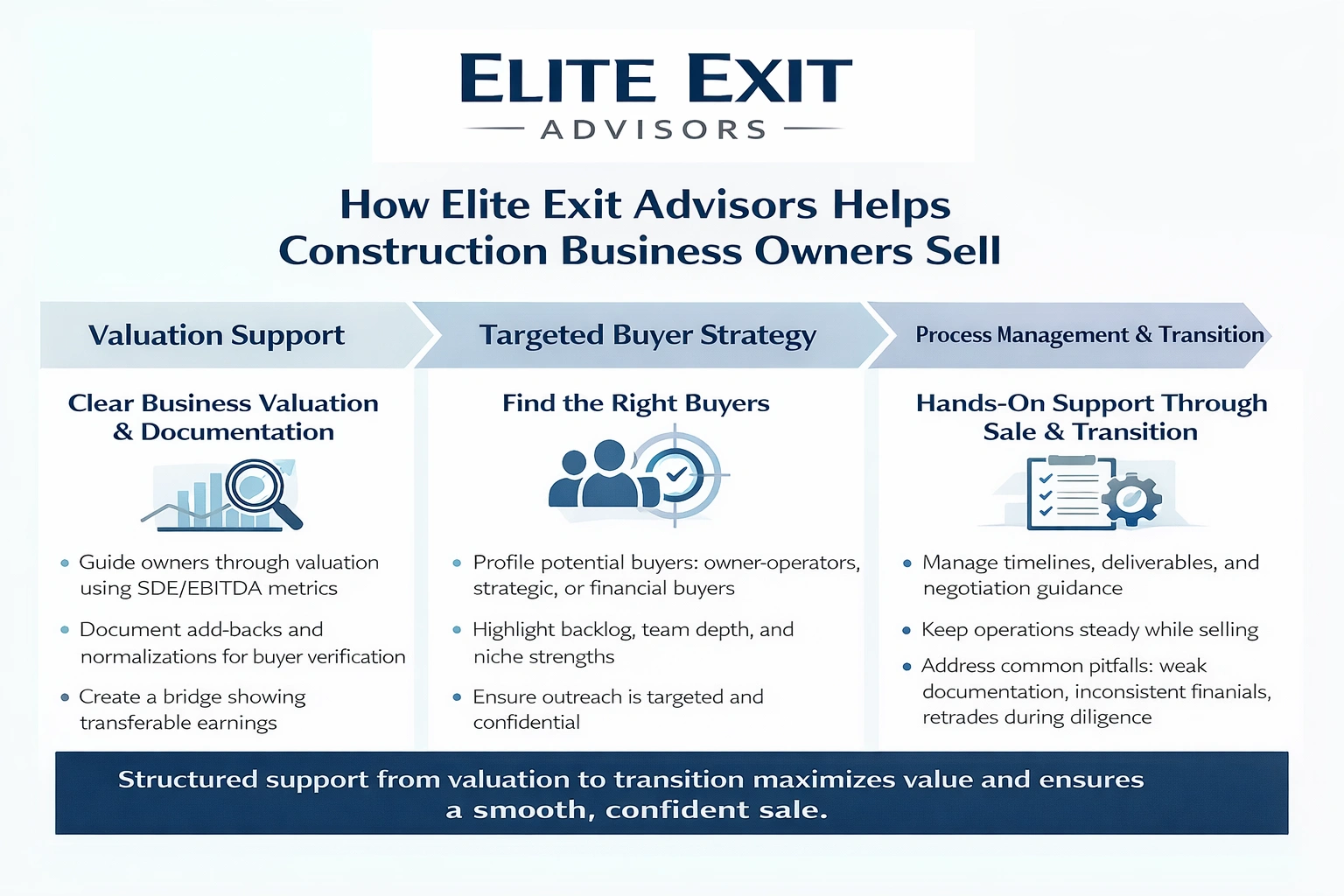
Elite Exit Advisors guides owners through valuation, buyer outreach, and transition planning while operations stay steady. The team focuses on clear business valuation, documenting add-backs, and building an SDE/EBITDA bridge that buyers can verify quickly.
We address common failure points: inconsistent financial stories, weak documentation, and preventable retrades during diligence.
Services include:
On the initial call we discuss goals, timing, and a brief financial and operational snapshot. We outline immediate next steps for sale readiness and confidentiality safeguards.
Book a call with Elite Exit Advisors: schedule a confidential review, get a valuation primer, and receive a short action plan for the next 90 days.
Wrap up your sale plan with a clear checklist that mirrors construction project controls.
Follow the roadmap: preparation, valuation, documentation, marketing, negotiation, diligence, closing, and transition. Each phase builds seller leverage and protects value in the market.
The biggest drivers of a strong outcome are clean financials, transferable operations, a stable team, a credible backlog, and clear positioning of services. These elements lift valuation and shorten timelines.
Treat the exit like a project: set scope, assign responsibilities, track milestones, and control risks. Time invested in preparation usually improves both price and terms.
Action step: identify your top three bottlenecks, owner dependence, documentation gaps, or revenue volatility, and fix them before going to market.