

When buyers look to purchase a business, their focus is far more strategic than simply buying what’s listed for sale. The most attractive companies share clear traits: predictable, sustainable cash flow; clean, verifiable financial records; and operations that can run successfully without the current owner. These core traits reduce risk, accelerate financing, and make the investment compelling, whether the buyer plans to run the business themselves or integrate it into a larger operation.
Data shows how critical predictable earnings are: businesses with low cash flow volatility (standard deviation below 15% over three years) sell for approximately 35% higher valuation multiples than those with unpredictable cash flows because reduced volatility directly lowers perceived risk for buyers.
In practical terms, buyers want evidence that a business will continue generating profit after ownership changes hands, not just a snapshot of past success. That’s why reliable cash flow, documented operations, defensible customers, and realistic growth opportunities form the foundation of what buyers value most in any acquisition opportunity.
Successful acquisitions start with clear thinking about downside risk, upside potential, and operational fit. Assessments focus on whether a target matches experience, running style, and the buyer’s ability to improve results without breaking what works.
Strategic acquirers pursue synergies, scale, and integration savings. Individual buyers often prefer stability, manageable complexity, and lifestyle fit. These different goals shape deal terms, financing appetite, and the scope of post-sale change.
Purchasing an existing business brings established customers and infrastructure that produce immediate revenue. That early cash reduces time-to-return, strengthens underwriting, and lowers perceived investment risk versus starting from zero.
Practical risk/return questions include payback period, month-to-month stability, and which operational changes are realistic. Smart parties press-test claims with documents, interviews, and focused diligence, not marketing language, so owners should prepare clear records in advance.
Buyers prize clear, repeatable income and simple operations that survive ownership change. The top priorities are reliable cash flow, operational transferability, and realistic growth paths. Sellers who document these elements reduce perceived risk and command higher value.
Stable cash flow shows as regular deposits, predictable margins, and a cushion for seasonality. Buyers expect profit that remains after normalizing owner pay and stripping one-offs, with bank statements and adjusted P&Ls to prove it.
Transferability requires written processes, trained staff, and systems that reproduce service quality without owner intervention. Evidence includes SOPs, role-based training, and performance dashboards.
Clear upside lists specific levers: pricing optimization, targeted marketing, capacity expansion, cross-sell and cost improvements. Buyers assess execution risk and staff depth, system complexity, and data to measure progress.

Sector and geography drive both risk perception and valuation. A clear industry fit gives underwriters confidence and speeds due diligence. Buyers favor sectors they know because prior experience makes operations easier to evaluate and improve.
Assess competitiveness and count rivals, note differentiation, and estimate customer switching costs. Margins must be read against industry benchmarks since thin profits can be normal in some markets.
Compare reported margins to peer ranges rather than guessing. That shows whether profitability is typical or a flag that needs explanation.
Location affects rent, wages, licensing, and access to suppliers or clients. Proximity to customer clusters can raise revenue potential. Remote sites may lower cost but limit market reach.
Individual buyers may reject a firm that requires relocation. Strategic buyers may seek a company in a target location to expand regional reach or improve logistics.
A sensible valuation separates the sticker price from the income a firm can sustain. Price is the number on the offer. Value is the expectation of reliable returns over time.
Start with cash flow. Buyers study recurring cash, normalized earnings, and how the company performs in slow months. The focus is earnings power: can cash support debt, growth, and owner pay after normalizing one-off items?
List tangible business assets: cash, equipment, inventory, vehicles, and property. Then capture intangibles: processes, data, intellectual property, and customer relationships.
Both types feed the overall valuation. A single high-value asset can change terms, as can strong customer data that supports future revenue.
Multiples convert earnings into a rough market value using comparable sales in the same sector. This sanity-check highlights overpricing versus similar companies and helps set negotiating ranges.
Risk reduces what a rational buyer will pay. Concentration of customers, weak controls, heavy capex needs, or key-person dependence compresses multiples and lowers acceptable price.
Buyers also budget for needed upgrades, hiring, marketing, and working capital after the sale. Every valuation method depends on credible documentation and consistent reporting to be useful in negotiations.
Clean, reconcilable records give the strongest signal that financial risk has been managed. Investors and lenders request source documents rather than summaries. That approach speeds diligence and lowers financing friction.
Review teams first check operating cash flow to see if day-to-day activity funds operations. Then they calculate free cash flow to estimate what remains for debt, growth, or distributions.
In short, disciplined diligence looks for clean matches across statements, bank activity, and filings. That clarity reduces uncertainty and helps move any deal toward financing and close.
Monthly liquidity patterns tell a clearer story about operational health than headline profit. Shortfalls often show as regular overdrafts, inventory pile-ups, or slow collections. Skilled acquirers verify timing, not just totals, because timing drives execution risk.
Working capital swings reveal hidden issues: receivables aging, inventory spikes, or delayed payables that mask cash pressure.
Even profitable companies fail when cash is locked up. Buyers review rolling 12-month bank activity, AR aging, and inventory turns to spot trouble.
Debt matters. Teams calculate debt-to-equity and debt-to-EBITDA to measure leverage.
Too much debt reduces flexibility and raises default risk. Lenders and acquirers flag high leverage as a negotiation point or contingency.
Interest coverage shows how comfortably operating earnings cover interest expense. Low coverage means higher vulnerability if margins tighten or rates rise.
These liquidity metrics directly affect valuation and deal structure: more risk often equals lower price, stricter reps, or larger escrows.

How fast invoices convert to deposits, and how long payables remain unpaid, drives short-term viability more than headline profit. Buyers test the cash conversion cycle to see how quickly sales become usable cash and how long the company delays supplier payments.
Review teams request aging schedules, write-off history, and concentration reports. They check if a few customers hold most past-due balances and whether customer payment timing has worsened recently.
Slow collections raise working capital needs and lower expected returns, since more capital sits in receivables instead of funding operations.
Extended payables can be a red flag. Persistent late payments may signal hidden liquidity strain or reliance on vendor tolerance.
Where one supplier supplies critical inputs, the company must show contract terms, switching costs, and continuity plans to reduce risk.
Operational durability matters as much as profit; fragile revenue can erase value overnight. Financial strength loses meaning if top clients, weak contracts, or single-person knowledge threaten continuity.
Buyers quantify dependency by percent of revenue tied to top accounts. Under 20% from any one client is often viewed as healthy. Recurring customers reduce month-to-month volatility and support predictable growth.
Teams inspect assignment clauses, consent requirements, personal guarantees, and escalation clauses. Contracts that require third-party approval or include owner guarantees raise transfer risk and cost.
Continuity depends on documented roles, retention plans, and cross-training. If institutional knowledge sits with one or two people, buyers budget for transition pay or hire replacements.
Centralized systems, clean data, and access controls make the company's metrics usable without rebuilding. Pending litigation, licensing gaps, or compliance issues create downside that changes terms or escrow needs.
Practical check: map top five customers, list assignable contracts, and document key staff roles before due diligence.
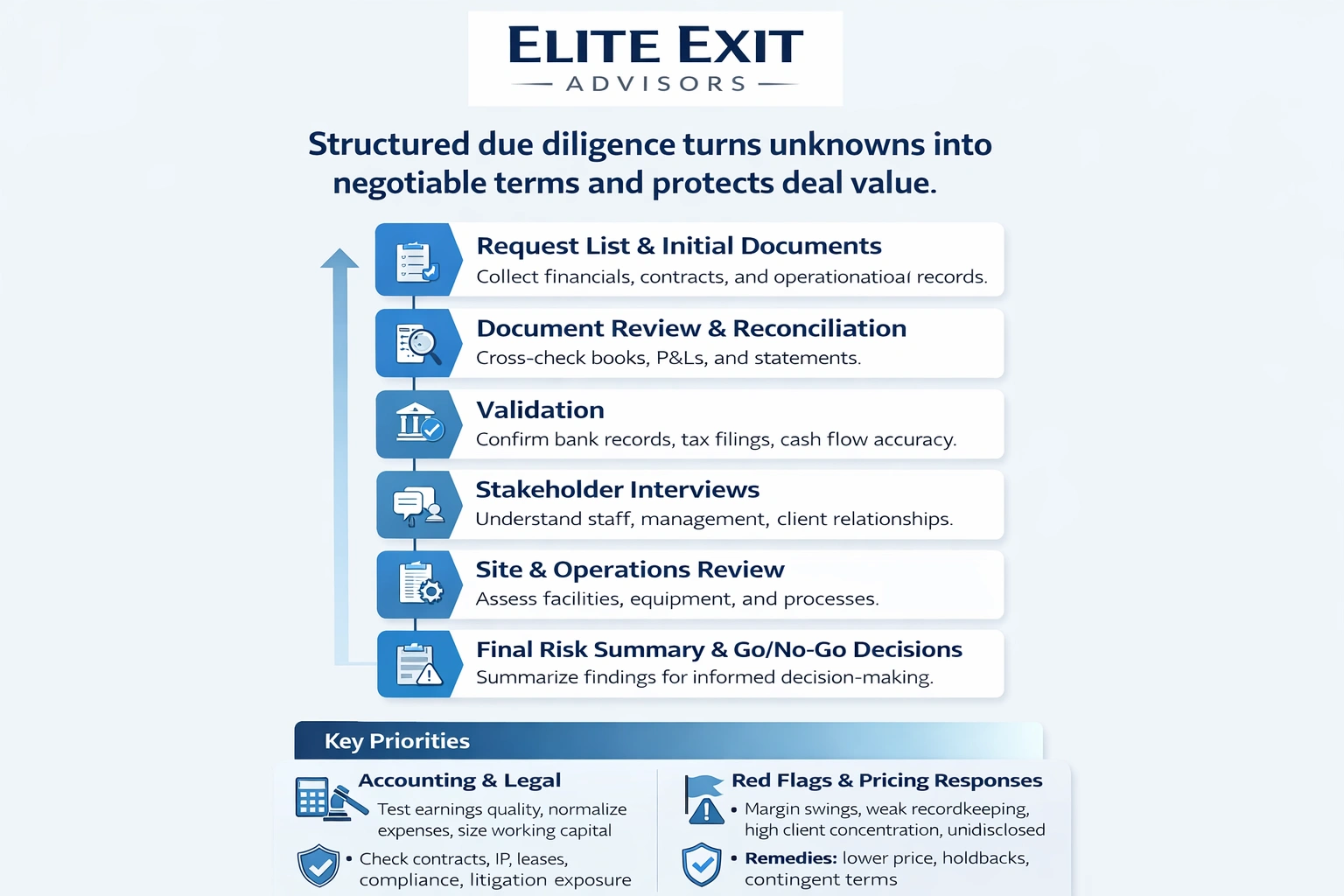
Structured review phases help convert unknowns into negotiable terms. A clear due diligence process keeps teams focused and protects value during the sale or purchase.
The typical diligence process follows six phases:
Work with an accountant to test earnings quality, normalize expenses, validate cash flow, and size working capital needs. Cross-check P&Ls, bank activity, and tax returns.
An attorney reviews contract assignability, lease terms, litigation exposure, compliance, ownership of assets and IP, and post-sale obligations.
Common red flags when buying a business that trigger repricing include unexplained margin swings, weak recordkeeping, high client concentration without contracts, aging receivables, and undisclosed liabilities.
Remedies: lower price, change payment terms, add holdbacks, or use contingent pricing tied to remediation milestones.
Typical protections are escrows for unknown liabilities, robust warranties and representations, indemnities for defined risks, and Material Adverse Change clauses to protect the purchaser between signing and close.
Preparation removes guesswork and gives sellers the clarity that underwriters demand. Elite Exit Advisors helps owners present clean financials, concise records, and a value narrative that speaks the language of transaction teams.
Our work focuses on reconciling statements, documenting defensible add-backs, and crafting a coherent company story tied to market opportunity.
Clear outcomes: reduced perceived risk, crisper cash flow metrics, and smoother diligence coordination.
Ready to reduce uncertainty and strengthen your sale outcome? Book a call to get a tailored plan based on timeline, company size, and market goals.
Closing well depends on matching reported results to verifiable records and systems.
Summary checklist: stable cash flow, real profit, transferable operations, diversified customers, and defendable contracts guide most purchase decisions. Clear documentation of assets, bank deposits, and tax returns speeds the process and reduces surprises.
Value comes from earnings power, tangible and intangible assets, and comparables, then adjusted for investment risk and post-close work. Industry and location set margin and growth expectations; time-to-return and the new owner’s ability to execute shape acceptable price and terms.
For small business owners and buyers of an existing business, disciplined verification of financials, contracts, and operations cuts deal risk and improves outcomes. Recurring customers, basic marketing, and systems that lower owner dependence typically raise worth and ease sale or purchase.