Buying a small business is a structured acquisition process that requires the same discipline as any major investment. First define your budget and target industry, then source opportunities, find a business to buy, review financials, validate operations, and negotiate terms before closing the deal and transitioning ownership. Each step builds on the previous one, and skipping even one can expose you to hidden risks.
The stakes are real. About 20% of small businesses fail within their first year and nearly 50% within five years, which means buying the right business, and buying it correctly, matters more than the idea itself. This is why a checklist is not optional; it’s your control system.
Key Takeaways
Use a structured checklist to guide financial and operational reviews.
Verify revenue, tax filings, and profit statements before any purchase.
Assess employees, equipment, and customer relationships for continuity.
Factor seller timing and transition plans into the final agreement.
Tap SCORE and local services for mentorship and legal help.
What Are the Benefits of Buying an Existing Business
Acquiring an existing company gives you immediate access to trackable performance and customer patterns. That historical financial data helps you assess viability and forecast cash flow with more confidence.
Established workflows mean inventory and service systems work from day one. You avoid many startup pains and can focus on improvements instead of building processes from scratch.
Advantages of Established Operations
Immediate brand recognition that helps retain customers and preserve revenue.
Longstanding supplier relationships that stabilize operations and purchasing.
Experienced staff who offer institutional knowledge and reduce training time.
Potential for the former owner to stay on and transfer crucial know-how.
Potential Risks to Consider
Even with clear books, hidden liabilities can surface. Contracts, pending claims, or tax issues may affect future costs.
Weigh asset benefits against these risks. Use due diligence to uncover gaps in records and ensure the company’s history supports its asking price.
Defining Your Personal and Professional Goals
Pinpoint income and legacy goals to guide which company fits your future. Decide how many hours you will work each week and what daily pace you want. This helps narrow which business models match your life.
List minimum income needs to live comfortably. Include taxes, health insurance, and retirement savings when you set targets.
Consider whether you want to transfer the company to family or sell later. That choice shapes structure, staffing, and long-term plans.
Assess risk tolerance honestly. High-growth opportunities may bring higher reward and more stress. Stable trades often give steadier cash flow and less volatility.
Weekly time commitment
Personal income target
Legacy or exit preference
Risk appetite and growth desire
Your goals will dictate the type of business you pursue and the due-diligence priorities to protect both lifestyle and financial aims.
Conducting Industry and Market Research
Map the market to see where demand and gaps intersect. This step shows whether the niche can sustain growth and where the company might stand out.
Performing a SWOT Analysis
Use a clear SWOT to list strengths, weaknesses, opportunities, and threats. Strengths reveal what the business does well. Weaknesses point to areas needing immediate attention.
Market research confirms the demand for the company’s niche and to forecast growth or decline.
Evaluate the industry outlook so the business can compete in its specific segment.
Analyze competitors to understand which products and services set this business apart.
A thorough SWOT helps you decide if the company fits your skills and interests.
Your interest level matters; commitment fuels problem solving and daily execution.
Combine these findings into a concise report that guides your next due-diligence steps. Use this analysis to price risk and spot practical improvements before you move forward.
A Comprehensive Buying a Small Business Checklist
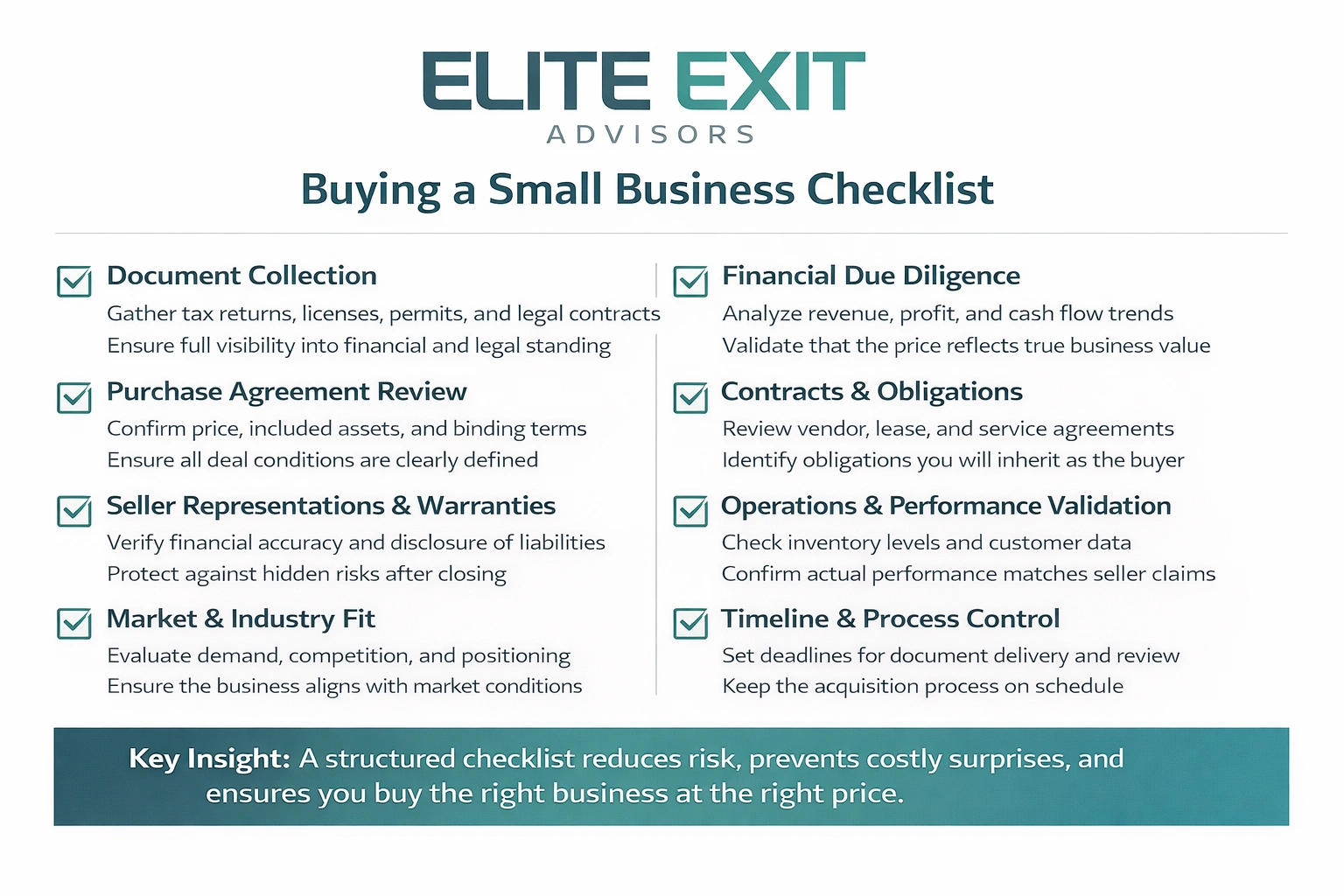
Gather all critical documents, from tax filings to permits, so nothing is missed during review. This ensures clear visibility into the company’s legal and financial standing before any purchase and helps you spot any red flags.
Require the purchase and sale agreement to state the agreed price, list assets included, and set the time the agreement becomes binding.
Ask the seller to warrant that revenue statements and financial reports are accurate and that no hidden liabilities exist. Insist this warranty appears in the agreement.
Collect documents: tax records, licenses, permits, and contracts tied to the company and its services.
Perform due diligence on the purchase price and on assets to avoid overpaying for the company.
Review seller contracts and agreements to identify terms you will assume as the new buyer.
Analyze customer information, inventory levels, and revenue statements to confirm performance claims.
Organize industry, product, and services information to evaluate market fit before finalizing the sale.
Keep timeframes strict, set deadlines for document delivery and for final review so the sale proceeds on schedule. Clear terms protect both buyer and owner and reduce surprises after closing.
Reviewing Entity Status and Regulatory Compliance
Verify that the entity holds current filings and clear regulatory records in its home state. A Certificate of Good Standing from the Secretary of State proves the company is authorized to operate. Request this early to confirm status and avoid surprise liabilities.
Verifying Good Standing
Ask for Articles of Incorporation, bylaws, and recent annual filings. These documents show how the company is structured and if reports or payments are overdue.
Check meeting minutes and governance agreements to spot recent decisions or ownership changes. Failure to file tax or state reports can place the company in bad standing and trigger fines or penalties.
Understanding Entity Types
Different entity types, LLC, S Corporation, C Corporation, have unique compliance rules. Confirm which terms apply, including franchise tax, reporting frequency, and governance requirements.
Incorrect tax filings affecting pass-through status
C Corporation
Bylaws, minutes, corporate tax filings
Double taxation issues or missed filings
All Types
Licenses, permits, Certificate of Good Standing
Expired permits that halt operations
Analyzing Financial Statements and Tax Records
Request audited financials spanning the last three years to verify revenue trends and cash flow stability. Compare those figures to RMA industry norms to spot outliers or soft growth.
Have your accountant review the company’s tax returns and income statements. They will flag inconsistencies, seasonal swings, and one-time items that distort true earnings.
Carefully analyze the debt schedule and fixed assets. This clarifies outstanding liabilities and the condition of key assets you may acquire.
Confirm audited statements and tax documents cover three fiscal years.
Compare performance to RMA benchmarks and peer companies in the industry.
Ask your bank early about financing based on valuation and purchase price.
Ensure the purchase agreement names included assets and that the seller indemnifies you against past tax claims.
Documents
Purpose
Who Reviews
Audited financial statements
Verify earnings and cash flow
Accountant
Tax returns
Confirm reported revenue and tax liabilities
CPA
Debt schedule & asset list
Identify liabilities and asset value
Buyer & bank
Evaluating Physical Assets and Equipment
Verify each item on the fixed-asset schedule against its physical location before you finalize the transfer.
Request a detailed list of assets with locations and serial numbers. Cross-check that list on-site to confirm the equipment included in the purchase matches what you see.
Maintenance records reveal how well the company has cared for machines. These documents show recent repairs, routine service dates, and parts history. Use them to estimate when major replacements will be needed.
Maintenance and Replacement Schedules
Ask for age, hours of use, and last service date for each asset. Older units may work now but can cause downtime soon after closing.
Verify condition and obsolescence risks for all physical assets and equipment.
Request a list of all locations and the equipment assigned to each site.
Review maintenance documents to plan future capital expenditures and avoid interruptions.
Assess whether current assets meet industry standards to protect the customer experience.
Confirm equipment leases are documented and understand transfer or termination terms.
Item
Key Document
What to Verify
Production Machine
Maintenance log & serial number
Service dates, hours used, warranty status
Point-of-Sale Terminals
Asset list & lease agreement
Lease transfer terms, software licenses, condition
Delivery Vehicles
Title, service records
Odometer, title status, repair history
Office Fixtures
Inventory by location
Presence at each site, wear, replacement needs
Assessing Intellectual Property and Intangible Assets
Verify that all proprietary software, designs, and know-how are assigned to the entity in the sale. Confirm who holds each patent, trademark, and copyright so transfer language is clear in the purchase agreement.
Have an attorney search for encumbrances such as licensing agreements or security interests. That review helps you spot restrictions that limit use of key rights.
Review work-for-hire records and consulting contracts to confirm creators assigned rights to the company. This step prevents future ownership claims that can disrupt operations.
Determine whether intellectual property is owned by the company or by individuals.
Document trade secrets and technical know-how included in the sale.
Confirm trademarks cover both products and services tied to the brand.
Ask your accountant to value IP for tax amortization over 15 years.
Investigating Customer Relationships and Market Reputation
Map who buys most often and why they return. Request customer lists with purchase history to see revenue sources and loyalty patterns. This helps you spot core segments that sustain the company.
Analyzing Customer Retention
Calculate repeat-purchase rates and cohort trends. Look for declining frequency or shrinking order sizes that signal churn.
Review customer surveys and past marketing plans to identify which products and services drive the most value. Visit nearby businesses to gauge local market health and future demand.
Monitoring Online Reviews
Scan Google Business Profile, Yelp, and industry forums. Reviews reveal service gaps, recurring complaints, and how the owner responds in public.
Check that customer agreements and licenses are transferable before the sale.
Confirm contact permissions and privacy documents are in the company’s records.
Evaluate social media interactions for tone and responsiveness to complaints.
Platform
What to Verify
Action
Google Business Profile
Recent reviews, owner responses
Document trends and flag recurring issues
Yelp
Rating changes, response patterns
Assess impact on local reputation
Social Media
Engagement, complaint handling
Record examples of strong and weak responses
Examining Employee Contracts and Benefits
List every team member, role, salary, and years of service. This roster reveals who keeps the company running and who you must retain after the purchase.
Collect all employment contracts, including non-compete and non-disclosure agreements, and review them with counsel. Confirm wage records, benefit summaries, and personnel files are complete.
Evaluate the employee handbook and benefit policies to gauge culture and ongoing costs.
Check workers’ compensation and unemployment claim history to spot liability trends.
Have an attorney review any collective bargaining agreements to avoid post-close disputes.
Analyze resumes and performance records to plan incentives for key employee retention.
Verify that payroll and employment tax filings are current to prevent unexpected obligations. Keep copies of all related documents and ensure transfer language in sale agreements protects you.
Item
What to Verify
Action
Employee list
Roles, salaries, tenure
Cross-check on-site
Contracts
NDAs, non-competes, offer letters
Legal review
Benefits
Health, retirement, leave policies
Cost and transfer assessment
Navigating Legal Risks and Pending Litigation
Compile a current schedule of disputes and threatened claims to measure the legal exposure you may inherit with the purchase.
Require the seller to deliver a complete list of pending suits, demand letters, and regulatory notices. That list helps you assign potential costs and time needed to resolve issues.
Have counsel review all material contracts, vendor, lease, and supplier agreements, to spot termination clauses, change-of-control triggers, or indemnity gaps that could create liabilities for the buyer.
Confirm all required licenses and permits are active and transferable under local zoning rules.
Investigate environmental risks, including any superfund or contamination exposure.
Audit insurance policies to ensure coverage for current claims and future litigation costs.
Set non-compete terms and time frames that protect the company from immediate competition by the seller.
Risk Area
What to Request
Who Reviews
Key Outcome
Litigation
Schedule of claims, case status, reserves
Attorney
Estimate of legal exposure
Contracts
Agreements with termination and assignment terms
Legal counsel
Flag red‑line changes before sale
Licenses & Permits
Renewal records, zoning clearance
Regulatory advisor
Confirm operational continuity
Insurance & Environmental
Policies, claims history, environmental reports
Broker & environmental engineer
Coverage gaps identified
How Elite Exit Advisors Facilitates Your Acquisition
Rely on experienced advisors to align valuation, financing, and contract terms for a smooth transfer.Elite Exit Advisors guides each step so you can focus on the target company and the future operations.
Our team performs a comprehensive valuation to determine a fair purchase price. We then prepare clear financial information that strengthens your presentation to the bank.
We provide strategic negotiation support to secure favorable deal terms. Our counsel also structures purchase agreements and related documents to reduce risk and protect value.
Comprehensive valuation to set a defensible price for the company.
Preparation of financial information to improve bank financing outcomes.
Negotiation support to shape terms that favor your objectives in the deal.
Drafting and review of agreements to minimize post‑close exposure.
Wrap your purchase process with clear milestones so each stage of due diligence finishes on schedule.
Focus on verified financial statements, tax records, and valuation so the purchase price reflects assets and market potential.
Confirm agreements and contracts transfer cleanly, and check licenses, permits, and inventory before the sale closes.
Verify employee status and customer information to protect continuity of services and limit unexpected liabilities.
Engage experts like Elite Exit Advisors to structure the agreement, tighten terms, and speed a smooth transition for the buyer and owner.
Taking the time now reduces risk later and helps you secure an aligned investment in the industry.
FAQs
Should I buy a business through a broker or directly from the owner?
›
Both approaches have advantages. Brokers can streamline the process, provide vetted listings, and assist with negotiations. Buying directly from an owner may offer more flexibility and potentially lower costs, but it requires more effort in sourcing and verifying information independently.
How do I determine if a business is overpriced?
›
Compare the asking price with industry valuation multiples such as EBITDA or revenue benchmarks. You should also assess asset value, cash flow consistency, and market conditions. A professional valuation or advisor can help confirm whether the price aligns with the business’s true worth.
What financing options are available for buying a small business?
›
Common options include bank loans, SBA loans (in the U.S.), seller financing, and investor partnerships. Some buyers also use personal savings or retirement funds. Each option has different requirements, interest rates, and risk levels, so it’s important to choose what fits your financial situation.
Do I need a lawyer to buy a small business?
›
Yes, hiring a lawyer is highly recommended. A legal expert will review contracts, ensure compliance, and identify potential risks in the agreement. This helps protect you from liabilities and ensures the transaction is structured properly.
How do I protect myself from seller misrepresentation?
›
Include representations and warranties in the purchase agreement that legally bind the seller to the accuracy of provided information. You should also conduct independent due diligence and request supporting documentation for all claims made by the seller.
What happens if the business underperforms after the purchase?
›
This risk can be mitigated through proper due diligence and deal structuring. Some agreements include earn-outs or seller financing tied to future performance, which can reduce upfront risk.
Is it better to buy assets or shares of a business?
›
An asset purchase allows you to select specific assets and avoid certain liabilities, making it a safer option in many cases. A share purchase transfers full ownership, including liabilities, but may be simpler in terms of continuity. The best choice depends on the specific deal and legal considerations.

.webp)

.webp)